The Times
The Hound of the BaskervillesThe Times is central to the London investigation not because its reporting explains the case, but because its printed words become part of a warning to Sir Henry Baskerville. Sherlock Holmes identifies the paper behind the message from its distinctive type, then treats the missing clippings as a physical trail to be followed. The newspaper thus functions at once as a mass-circulation text, a source of anonymous communication, and an object of forensic scrutiny.
The newspaper as printed source
The Times enters a wider sequence of printed evidence when Dr. Mortimer brings a folded copy of the Devon County Chronicle to Sherlock Holmes and reads its account of the circumstances surrounding the death of Sir Charles Baskerville. That newspaper is not The Times: it supplies a public report of an earlier event, while The Times becomes evidence in the immediate threat against Sir Henry. The distinction matters. One paper records what has happened; the other supplies the raw material from which someone constructs a message about what may happen next.
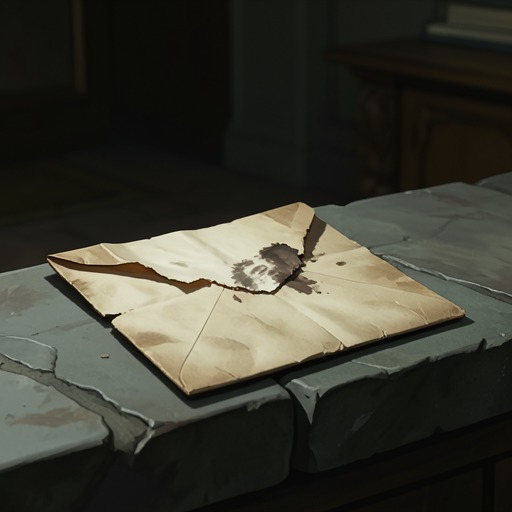
The warning reaches Sir Henry at the Northumberland Hotel in an envelope addressed in rough printed characters and postmarked at Charing Cross. Inside is a half-sheet of foolscap folded into four. Printed words pasted across it form an instruction to keep away from the moor; only the word moor is written in ink. The message is therefore a composite object: its wording is assembled from print, while its one handwritten term identifies the danger more precisely. Its makers have turned an ordinary newspaper page into a means of communicating anonymously.
Holmes identifies the source
Holmes tests the warning against a copy of the previous day’s Times. He asks for the inside page containing the leading articles and reads aloud from an article on free trade. Its argument concerns the possible effects of protective tariffs on national wealth, imports, and general living conditions. To Sir Henry, this appears to take the discussion away from the threatening note. Holmes, however, is using the article as a comparison text: the warning’s vocabulary can be matched against words printed in its columns.
The comparison reveals that words in the message—including its references to life, reason, value, and keeping away—have been cut from the article. Holmes adds that keep away and from the were taken as single pieces, a detail that helps show how the message was physically assembled. The source is not inferred merely from the warning’s meaning. Holmes relies on the appearance of the type, distinguishing the Times leader from the slovenly print of an evening halfpenny paper. He recalls having confused two newspaper types when young, but presents recognition of print styles as elementary to specialist crime detection. In this instance, typography narrows the search to a particular publication and, because the warning was assembled the previous evening, to a particular issue.
Holmes’s brief enthusiasm for the article’s political argument also serves the inquiry. He praises its sentiments to Dr. Watson while Sir Henry remains puzzled, creating the appearance of a digression. The apparent detour is the method: the article must be inspected closely enough to establish the wording and its source. What seems like unrelated editorial matter becomes a set of matching fragments, and a newspaper’s ordinary layout becomes a map for reading a threat.
From printed clue to investigative search
Identifying The Times is only the beginning. Holmes instructs an agent to visit hotels and ask for the previous day’s waste paper, giving a false explanation about a missing telegram. The real object of the search is the Times page from which words have been cut. He supplies a copy so the agent can recognize the page, and provides money for tips to the outside and hall porters: one shilling in each case, with twenty-three shillings for the visits and ten more for emergencies. Holmes expects that in perhaps twenty of the twenty-three cases the waste will already have been burned or removed; only in the remaining three might a heap of paper be available to search. He asks for a report by wire to Baker Street in London before evening.
This plan follows the paper beyond the printed page into the practical circulation of waste. The clipping has been taken from a specific issue, but the source page may have passed through hotel rooms and been discarded with other paper. Holmes’s inquiry therefore depends on ordinary routines of handling and removing refuse as well as on his ability to read type. The evidence establishes the proposed search, not its result; its significance here is the chain of inference that makes the newspaper page worth pursuing.
The warning’s maker and the limits of print
The later reconstruction connects the newspaper fragments to the danger surrounding Sir Henry. Stapleton follows Dr. Mortimer through London, to Baker Street in London, the station, and the Northumberland Hotel, disguised by a beard. His wife, Mrs. Stapleton, has some knowledge of his plans but is afraid to warn Sir Henry openly because of her husband’s brutal treatment and her fear that a letter would be discovered. She cuts out words to form the warning and addresses it in a disguised hand. The use of The Times is thus part of a constrained attempt to transmit information without exposing its sender.
The paper’s role has two opposing sides. Its distinctive type enables Holmes to identify the source, while its detachable words allow the warning’s maker to conceal her own wording in material printed for a broad readership. But the method does not erase every trace: the inked word, the cut edges, the particular phrasing, and the page’s type all preserve clues. In the case’s information trail, a newspaper can carry public argument, be transformed into private warning, and then return as evidence under examination.